A new experience of a legendary story
Discover
the Spirit of Schengen
Welcome to the Schengen Museum – dedicated to the history and significance of the Schengen Agreement, a milestone of European integration. Located in the heart of the magic triangle, where Luxembourg and the Benelux countries meet Germany and France. Discover the immersive new exhibition next to the Moselle River, and relive the signing of the iconic Schengen Agreement on board the original boat, Prinzessin Marie-Astrid Europa.
Celebrating 40 years of Freedom in Motion
The Schengen Museum
Today, the Schengen experience unfolds in two unique locations. Inside the newly redesigned Schengen Museum, visitors explore the past, present, and future of a borderless Europe through an immersive exhibition. Just steps away, you can board the original Prinzessin Marie-Astrid Europa and relive the historic moment where it all began.
© Courtesy of Migliore+Servetto / Andrea Martiradonna
The Museum
Intuitive, interactive and playful – The exhibition inside the museum building is an engaging journey to experience diversity, possible intersections and integration, which also alternates moments of exploration and reflection.
© Courtesy of Migliore+Servetto / Andrea Martiradonna
The Boat
The upper deck: a time machine – The signing room allows the visitors to travel back in time, transporting them to the same space that welcomed the representatives of the first signatory countries of the Agreement in 1985.
Personalised participative educational
The Schengen Museum is more than an exhibition: it’s a dynamic, borderless experience. Here, visitors engage with history and ideas in immersive spaces designed to spark reflection and connection. Through innovative multimedia, personal stories, and interactive stations, the museum invites all generations to explore the past, present, and future of open borders and European cooperation.
Our offer
© Courtesy of Migliore+Servetto / Andrea Martiradonna
Individuals
Visiting on your own out of personal interest? Discover the legacy of open borders, European integration, and shared identity through our engaging exhibition and personal stories.
© strglng_henrigoergen
Children & Families
With our creatively designed children’s booklet, a visit to the museum becomes a real adventure! Young explorers dive into the themes and stations of the exhibition in a playful and interactive way. Puzzles, tasks, and exciting prompts invite them to get involved, look closely, and discover the museum with curiosity and enthusiasm.
© Centre Européen Schengen asbl
Groups
Are you planning a visit with a group? Feel free to contact us in advance – this allows us to make the best possible arrangements for your visit.
School Groups
School groups can engage with hands-on installations that connect classroom learning to real-world topics like borders, free movement, and European cooperation, making history come alive for students.
Memorials along the riverside
From October 9, 2026 to October 8, 2027
Borders, Mobility, and their Human Impact
Short film programme on the Prinzessin Marie-Astrid Europa
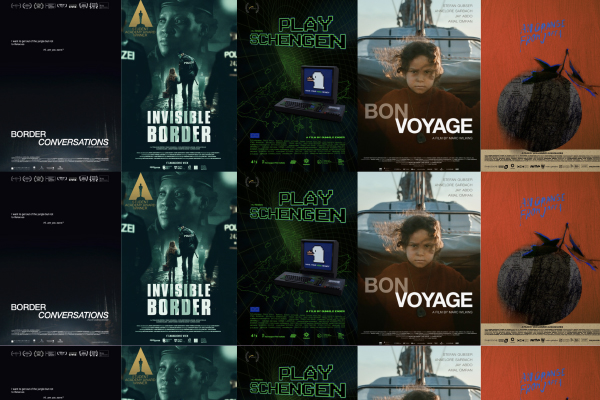
Five short films explore the human impact of borders, migration and restricted freedom of movement as part of the film programme “Borders, Mobility, and their Human Impact”. Although produced in different countries and at different times, the films share a common question: What do borders mean for people who seek to cross them, are prevented from doing so, or find themselves caught between different political and social systems? Through this program, the Schengen Museum aims to open up different perspectives on these issues and give a voice to filmmakers from diverse backgrounds and with different experiences. At the same time, encounters between filmmakers and audiences are at the heart of the program.
FIVE FILMS – FIVE PERSPECTIVES
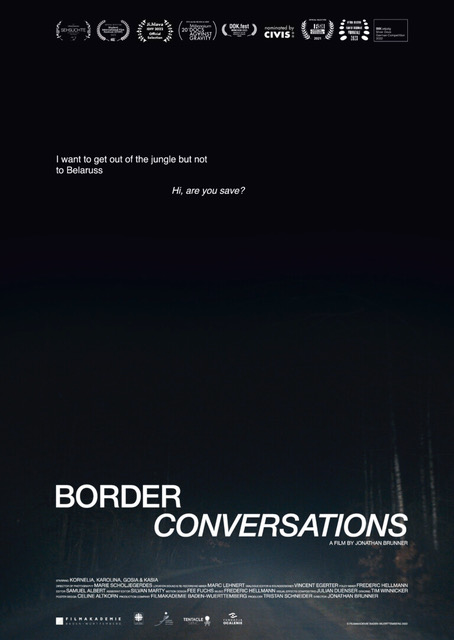
BORDER CONVERSATIONS
Directed by Jonathan Brunner | Germany, 2022 | 30 min
In November 2021, thousands of people attempt to enter the EU across the border between Belarus and Poland. Two Polish activists receive daily calls for help and try to support people in the border region. The film explores the limits of humanitarian aid and the experience of helplessness. Border Conversations received awards at DOK Leipzig and DOK.fest Munich, among other distinctions.
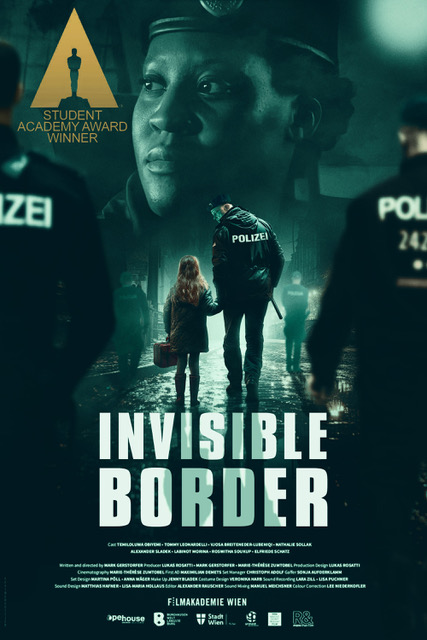
INVISIBLE BORDER
Directed by Mark Gerstorfer | Austria, 2022 | 27 min
A deportation in Vienna escalates. Police officers Nancy and Albert, together with a police unit, are tasked with removing an Albanian family without a valid residence permit from their apartment. The film confronts those involved with a situation that leaves traumatic consequences for everyone. Invisible Border received the Student Academy Award Gold Medal and the Austrian Film Award for Best Short Film.
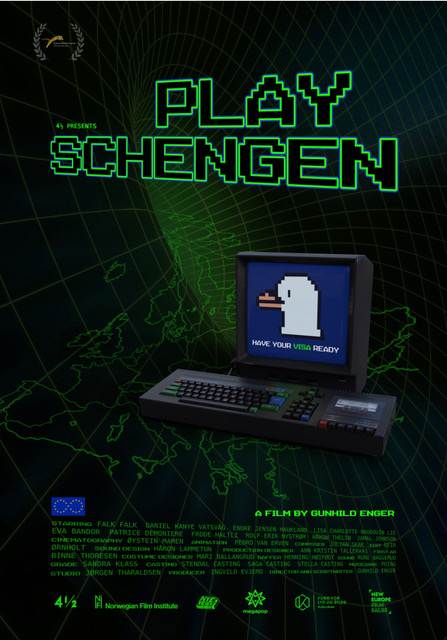
PLAY SCHENGEN
Directed by Gunhild Enger | Norway, 2020 | 14 min
Two game designers develop a video game for children intended to explain the European Union and the Schengen system. Players take on the role of a national bird that may only fly across borders according to its visa. With humour and absurdity, the film asks whether the complexity and inequalities of borders can really be translated into a children’s game.
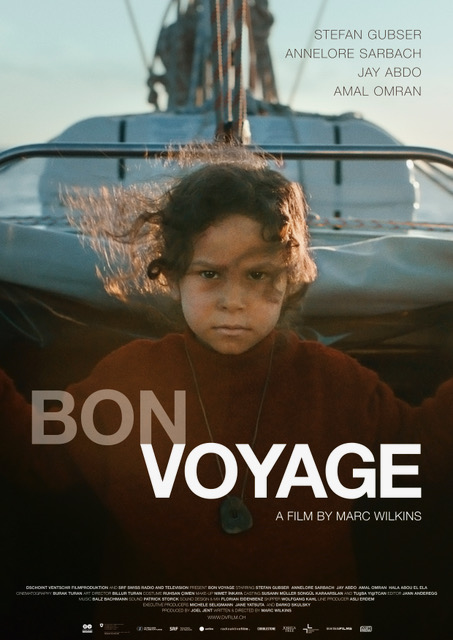
BON VOYAGE
Directed by Marc Raymond Wilkins | Switzerland, Turkey, 2016 | 21 min
A Swiss sailing yacht discovers a disabled refugee boat in the Mediterranean. When some of the refugees manage to come aboard, the situation spirals out of control. The multiple award-winning short film received, among other distinctions, the Swiss Film Award for Best Short Film and a Jury Award at the Palm Springs International ShortFest. It was also shortlisted for the 89th Academy Awards.
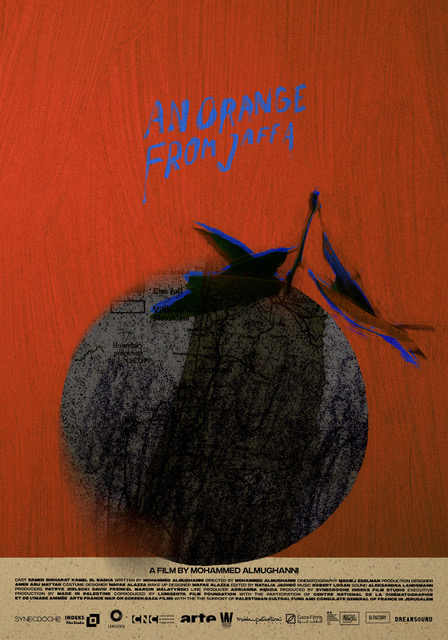
AN ORANGE FROM JAFFA
Directed by Mohammed Almughanni | Palestine, Poland, France, 2024 | 27 min
Mohammed, a young Palestinian, attempts to cross an Israeli checkpoint using a temporary Polish residence card. After several drivers refuse to take him, a taxi driver offers him a ride. But when Israeli soldiers discover that Mohammed has already tried unsuccessfully to cross the checkpoint, the situation quickly escalates. The film has received numerous international awards, including the Grand Prix at the Clermont-Ferrand International Short Film Festival, Best European Short Film at the Krakow Film Festival and the Louis Le Prince Award at the Leeds International Film Festival. An Orange from Jaffa was also shortlisted for the 2025 Academy Award for Best Live Action Short Film.
Total program duration: approximately 2 hours 30 minutes
© Centre Européen Schengen asbl
© Marian Wilhelm
From 14 June to 13 September 2026
To/After/Beyond the Border
by Silke Markefka and Nikolai Vogel
Borders aren’t places to linger – they’re passages. Open them here, close them there. In 2008 and 2009, artists Silke Markefka and Nikolai Vogel explored Germany’s border crossings with its nine neighbouring countries. They documented the eerie aftermath as barriers vanished: dismantled structures overgrown with neglect, crumbling into ruins, or standing as surreal relics from a bygone era. The 1985 Schengen Agreement and its 1990 Implementation Convention (Schengen I and II) had, since the mid-1990s, rendered these infrastructures obsolete, reverting many crossings to ordinary roads. Passport checks ended with Belgium, France, Luxembourg, and the Netherlands in 1995; Austria in 1998; Denmark in 2001; Poland and the Czech Republic by late 2007; and Switzerland by late 2008. Controls shifted to outer EU frontiers, enforced more rigorously. Now, as they return even around Germany, this work offers a poignant retrospective on a time when borders nearly faded away.
Painter Silke Markefka captured her impressions in striking medium- and large-scale works – not as literal scenes, but as layered memoryscapes, blending overpainting and revelation to evoke time’s strata. Her intuitive approach invites viewers to forge personal connections. Writer and artist Nikolai Vogel recorded the sonic essence of these sites with analogue devices from the same fading epoch – tape machines, reel-to-reels, dictaphones, and cassette recorders – while crafting associative texts that deepen the immersion.
The sensation of gliding past a barrier gate… Paintings and soundtracks from an era when borders seemed to dissolve. An evocative tour through 22 sites, born when Schengen opened pathways without checks – yet now reimposed. To/After/Beyond the Border confronts today’s realities with once-bright visions of a freer world, probing history itself.
Encompassing painting, photography, literature, field recordings, and performance, the project earned the 2008 Munich City Visual Arts Project Grant. It inspired Nikolai Vogel’s 50-minute BR radio play, premiered on Bayern 2 in 2011. Installations have appeared in galleries and museums, including the 2024 Vom Teilen | About Sharing | O Dzieleniu – Kunst an der (polnisch-deutschen) Grenze exhibition at Berlin’s ZAK Centre for Contemporary Art and a major 2025 solo show at Munich’s Muffatwerk. The accompanying reader/artist’s book Nach der Grenze was published by Black Ink Verlag.


Artist Biographies
Painter Silke Markefka (1974, Mühldorf am Inn; lives in Munich) and writer/artist Nikolai Vogel (1971, Munich; lives in Munich) have collaborated on innovative projects and exhibitions for years alongside their individual practices.
Silke Markefka studied painting at Munich’s Academy of Fine Arts under Prof. Günther Förg (2002 – 2008, Master Class 2006). Awards include the 2007 Villa Romana Prize, 2008 Munich Visual Arts Grant, 2010 BBK Munich Debut Award, and 2013 Bavarian Art Prize. Her series-based works – Archiv, Lüster, Kinder, Touristen, Von Vorhängen – peel back layers of memory and intimacy, balancing figuration and abstraction. They evoke fleeting glamour, the grasp at time’s passage, and longing born of absence.
Nikolai Vogel studied German literature, philosophy, and computer science at LMU Munich. His associative art and writing embrace reality’s fragments and openness. Honors: Open Mike 2004 and Ingeborg Bachmann Prize 2005 finalist; Berlin Literary Colloquium Fellowship 2005; Bavarian Literature Prize 2007; Munich Visual Arts Grant 2008; 2012 Munich Public Art Competition win. Key publications: Spam Diamond (Haymon, 2012); fragmente zu einem langgedicht (gutleut, 2019); Angst, Saurier (YouTube readings, 2020); recent titles from Black Ink including Hier und ohne uns (2026). With Kilian Fitzpatrick, he runs Black Ink Verlag and performs as electropop duo Schlachtbach.
© Centre Européen Schengen asbl
The Berlin Wall
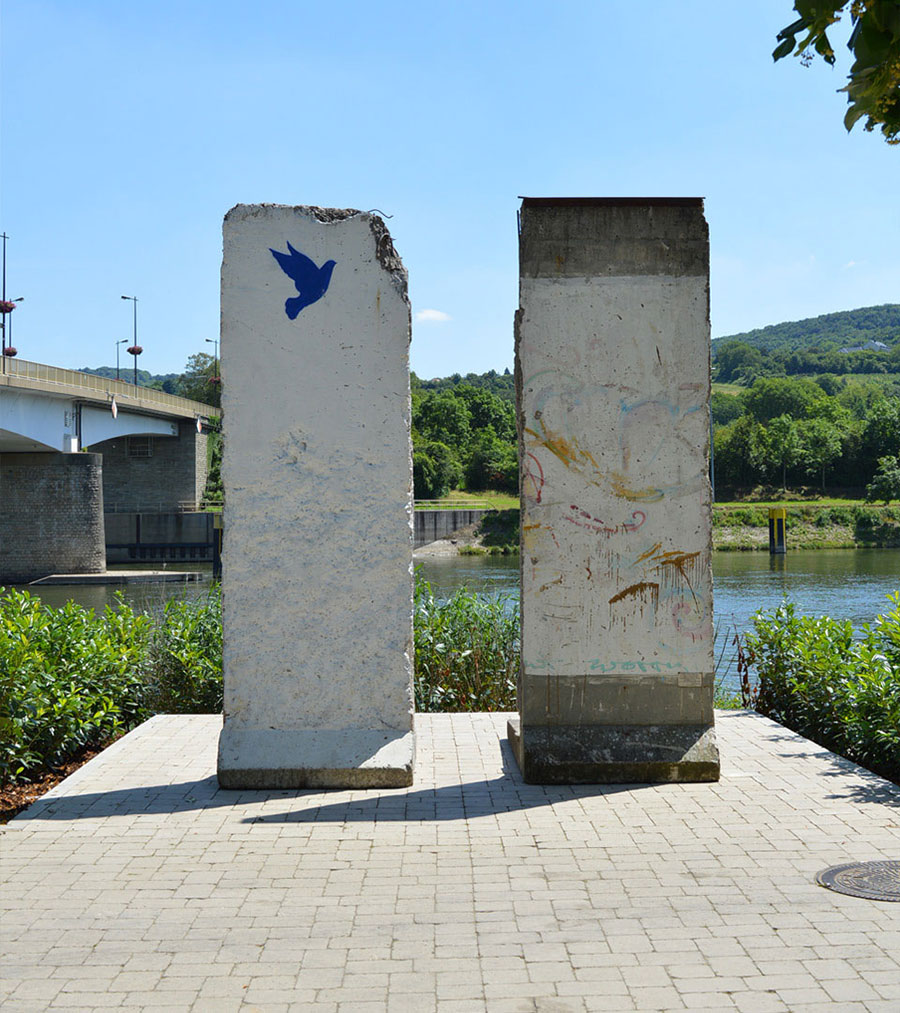
As powerful symbols of Europe’s reunification, two original segments of the Berlin Wall are prominently displayed in the symbolic heart of Schengen, near the Museum. One was a gift from the Berlin Senate in 2010; the other, added in 2015, features a peace dove and a portrait of Mikhail Gorbachev, the last leader of the Soviet Union, known for his reforms that helped end the Cold War. Together, they invite visitors to reflect on the fall of borders and the spirit of unity that defines Schengen. These historic fragments serve as a lasting reminder of Europe’s commitment to peace, freedom, and cooperation.
© Centre Européen Schengen asbl
Upcoming Events & Activities
Click here to show or hide
“
The value of a museum is not just in its collection but in the relationship it established with its visitors.
Ico Migliore – Migliore+Servetto
Step into the Schengen Region
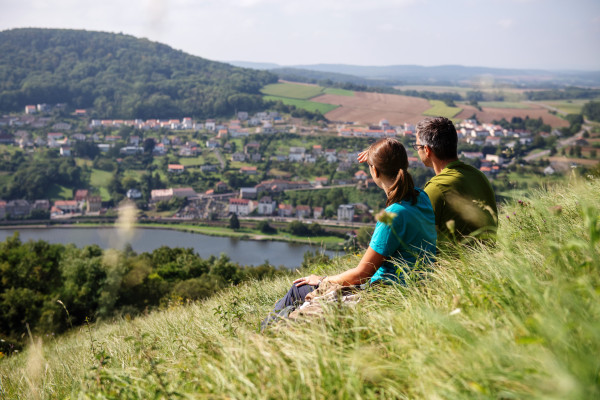
The Schengen Museum is your starting point for exploring the region where borders fade and cultures meet. At the official Tourist Info desk, you’ll get maps, travel tips, and personal advice to plan your visit. Discover the stories inside the museum – then step out to experience the landscapes, history, and local life that surround it.